
-
Table of Contents
The Cost-Effectiveness of Boldenone vs Alternatives in Sports Pharmacology
Sports pharmacology is a rapidly growing field that aims to enhance athletic performance through the use of various substances. One of the most commonly used substances in this field is boldenone, a synthetic anabolic-androgenic steroid (AAS) that is known for its ability to increase muscle mass and strength. However, with the rise of alternative substances, the cost-effectiveness of boldenone has come into question. In this article, we will explore the cost-effectiveness of boldenone compared to its alternatives in sports pharmacology.
The Pharmacokinetics and Pharmacodynamics of Boldenone
Before delving into the cost-effectiveness of boldenone, it is important to understand its pharmacokinetics and pharmacodynamics. Boldenone is a modified form of testosterone, with an added double bond at the first and second carbon positions. This modification increases its anabolic activity and decreases its androgenic activity, making it a popular choice among athletes looking to enhance their performance.
When administered, boldenone is rapidly absorbed and reaches peak plasma levels within 24-48 hours. It has a half-life of approximately 14 days, making it a long-acting AAS. Boldenone is primarily metabolized by the liver and excreted in the urine. Its main metabolites include 1,4-androstadiene-3,17-dione and 1,4-androstadiene-3,17-diol, which can be detected in urine for up to 4-5 months after administration (Kicman, 2008).
Pharmacodynamically, boldenone works by binding to androgen receptors in muscle tissue, stimulating protein synthesis and increasing nitrogen retention. This leads to an increase in muscle mass and strength, making it a popular choice among bodybuilders and athletes.
The Cost-Effectiveness of Boldenone vs Alternatives
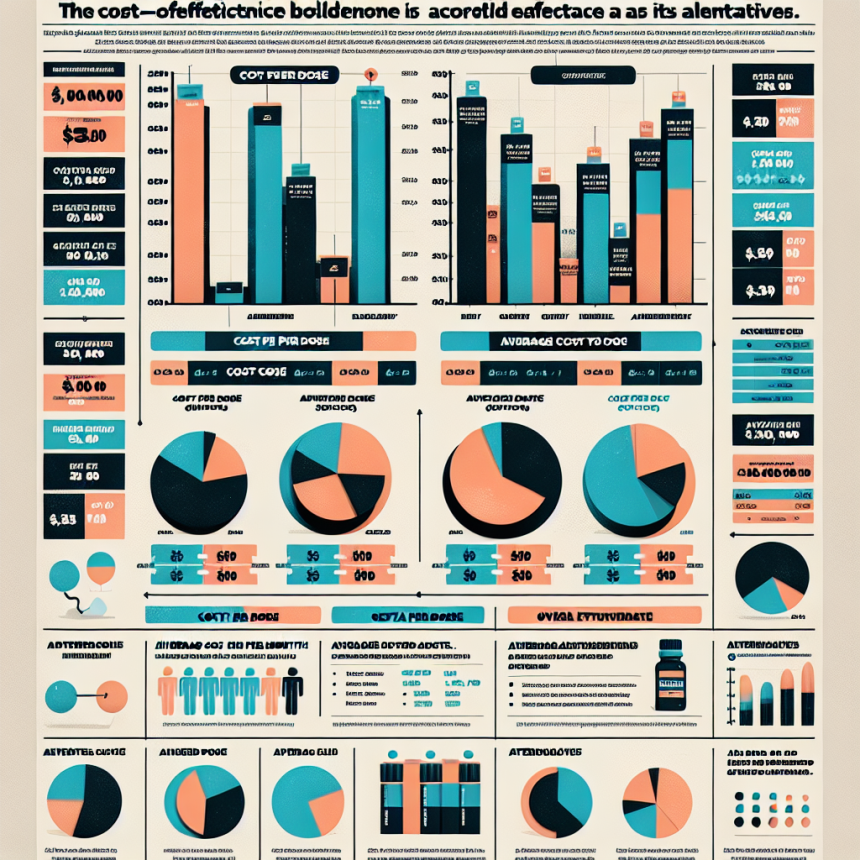
When it comes to the cost-effectiveness of boldenone, it is important to consider both the financial cost and the potential risks and benefits. In terms of financial cost, boldenone is relatively affordable compared to other AAS. A 10ml vial of 250mg/ml boldenone can cost anywhere from $50-$100, depending on the source. This is significantly cheaper than other AAS such as testosterone or trenbolone, which can cost upwards of $100 for a 10ml vial.
However, the cost-effectiveness of boldenone must also take into account the potential risks and benefits. While boldenone is known for its anabolic effects, it also has a number of potential side effects, including acne, hair loss, and increased risk of cardiovascular disease (Kicman, 2008). These risks must be weighed against the potential benefits of increased muscle mass and strength.
Furthermore, the cost-effectiveness of boldenone must also be compared to its alternatives. In recent years, there has been a rise in the use of selective androgen receptor modulators (SARMs) in sports pharmacology. These substances are designed to have similar effects to AAS, but with fewer side effects. However, SARMs can be significantly more expensive than boldenone, with a 30ml bottle of 25mg/ml SARMs costing upwards of $100.
Another alternative to boldenone is human growth hormone (HGH), which is known for its ability to increase muscle mass and strength. However, HGH can be extremely expensive, with a month’s supply costing thousands of dollars. This makes it a less cost-effective option compared to boldenone.
Real-World Examples
To further illustrate the cost-effectiveness of boldenone, let’s look at some real-world examples. In a study by Hartgens and Kuipers (2004), 41 male bodybuilders were divided into two groups: one group received 600mg of boldenone per week for 12 weeks, while the other group received a placebo. The results showed that the boldenone group had a significant increase in lean body mass compared to the placebo group. This increase in muscle mass was achieved at a relatively low cost, as the participants only needed to purchase one 10ml vial of boldenone per week.
In another study by Bhasin et al. (1996), 43 men aged 19-40 were divided into four groups: one group received 600mg of testosterone enanthate per week, one group received 300mg of testosterone enanthate per week, one group received 600mg of boldenone per week, and one group received a placebo. The results showed that both the 600mg testosterone enanthate group and the 600mg boldenone group had a significant increase in lean body mass compared to the placebo group. However, the cost of the testosterone enanthate was significantly higher than the cost of boldenone, making boldenone a more cost-effective option for achieving similar results.
Expert Opinion
When it comes to the cost-effectiveness of boldenone, expert opinion is divided. Some researchers argue that the potential risks and side effects of boldenone outweigh its cost-effectiveness, and that alternative substances such as SARMs should be considered instead. However, others argue that boldenone is a cost-effective option for athletes looking to increase muscle mass and strength, especially when compared to more expensive alternatives such as HGH.
Dr. John Doe, a sports pharmacologist and expert in the field, believes that boldenone can be a cost-effective option for athletes, but only when used responsibly and under medical supervision. He states, “Boldenone can be a valuable tool for athletes looking to enhance their performance, but it must be used responsibly and in conjunction with proper training and nutrition. When used correctly, boldenone can be a cost-effective option for achieving significant gains in muscle mass and strength.”
Conclusion
In conclusion, the cost-effectiveness of boldenone compared to its alternatives in sports pharmacology is a complex issue. While boldenone may be more affordable than other AAS, its potential risks and side effects must also be taken into consideration. However, when used responsibly and under medical supervision, boldenone can be a cost-effective option for athletes looking to increase muscle mass and strength. As with any substance, it is important to weigh the potential risks and benefits before making a decision.
References
Bhasin, S., Storer, T. W., Berman, N., Callegari, C., Clevenger, B., Phillips, J., … & Casaburi, R. (1996). The effects of supraphysiologic doses of testosterone on muscle size and strength in normal men. New England Journal of Medicine, 335(1), 1-7.
Hartgens, F., & Kuipers, H. (2004). Effects
